
Antonio Vivaldi wrote at least three settings of the hymn Gloria in excelsis Deo, whose words date probably from the 4th Century and which is an integral part of the Ordinary of the Mass. Two survive: RV 588 and RV 589. A third, RV 590, is mentioned only in the Kreuzherren catalogue and presumed lost. The RV 589 Gloria is a familiar and popular piece among sacred works by Vivaldi. It was probably written at about the same time as the RV 588, possibly in 1715.
- Download Vivaldi. Vivaldi browser runs on Windows, Mac and Linux. Select your operating system below to get started. Vivaldi browser protects you from trackers, blocks unwanted ads, and puts you in control with unique built-in features.
- Vivaldi - GloriaNATIONAL CHAMBER ORCHESTRA OF ARMENIAArt director V. MartirosyanNATIONAL CHAMBER CHOIR OF ARMENIAArt director R. Mlkeyansoprano M.
Introduction [edit]
Vivaldi is a new browser that blocks unwanted ads, protects you from trackers, and puts you in control with unique built-in features. Get Vivaldi and browse fast.
As with other choral pieces the composer, Vivaldi, wrote many introduzione (introductory motets) that were to be performed before the Gloria itself. Four introduzioni exist for these Glorias: Cur Sagittas (RV 637), Jubilate, o amoeni cori (RV 639) (the last movement of which is compositionally tied with the first movement of RV 588), Longe Mala, Umbrae, Terrores (RV 640), and Ostro Picta (RV 642).
Settings[edit]
RV 588[edit]
The lesser known of the two surviving Glorias, RV 588 was most likely composed during Vivaldi's employment at the Pio Ospedale della Pietà, known for its advanced choral ensemble. The first movement is interwoven with the last aria of RV 639, as explained above. The date of composition between this Gloria and RV 589 is still disputed, but both show compositional inspiration from each other.
RV 588 borrows extensively from a double orchestra-and-choir setting of the same text by Giovanni Maria Ruggieri (which will henceforth in this article be referred by its RV cataloguing number of RV. Anh. 23). Many movements show inspiration from this composition, and two movements ('Qui Tollis' and 'Cum Sancto Spiritu') are plagiarised from the original Ruggieri setting (although 'Qui Tollis' completely omits the second coro (chorus), and 'Cum Sancto Spiritu' is slightly modified). The first movement of RV 588 is also an extended version of RV Anh. 23, sans the second coro employed in RV Anh. 23, among other musical modifications. The second movements of both RV 588 and RV 589 ('Et in Terra Pax') both show chromatic patterns and key modulations similar to that of the second movement of RV Anh. 23.
Movements[edit]
- Gloria in excelsis Deo (Chorus)
- Et in terra pax (Chorus)
- Laudamus te (Sopranos I and II)
- Gratias agimus tibi (Chorus)
- Propter magnam gloria (Chorus)
- Domine Deus (Soprano)
- Domine, Fili unigenite (Chorus)
- Domine Deus, Agnus Dei (Alto, Chorus)
- Qui tollis peccata mundi (Chorus)
- Qui sedes ad dexteram Patris (Mezzo Soprano)
- Quoniam tu solus sanctus (Chorus)
- Cum Sancto Spiritu (Chorus)
RV 589[edit]
This is the better known setting of the Gloria, simply known as the Vivaldi 'Gloria' due to its outstanding popularity. This piece, along with its mother composition RV 588, was composed at the same time during Vivaldi's employment at the Pietà. Two introduzioni exist as explained in the aforementioned article.
As in RV 588, there exists evidence of influence by RV Anh. 23: the first movement's chorus shares similar key modulations to that of the first movement of RV 588, only modified to fit a duple meter instead of the triple meter of RV 588. Motivic material present in the orchestral parts of either piece are also shared, including octave jumps in the opening motives of the piece. The second movement is significantly more chromatic in RV 589, but nonetheless is texturally similar to the setting present in RV Anh. 23, with the use of repeating rhythmic figures underneath harmonic motion. The 'Qui Tollis' movement of RV 589 is rhythmically similar to the first few measures of RV 588 (and ultimately RV Anh. 23). The last movement, 'Cum Sancto Spiritu,' is essentially an 'updated' version of movement present in both RV Anh. 23 and RV 588, except extensively harmonically modified, becoming more chromatic than its predecessors, reflecting a maturity in Vivaldi's output and the emerging style of the late Italian Baroque.
Movements[edit]
Domine Deus for soprano, oboe and string orchestra. Courtesy of Monora. | |
| Problems playing this file? See media help. | |
- Gloria (Chorus)
- Et in terra pax (Chorus)
- Laudamus te (Sopranos I and II)
- Gratias agimus tibi (Chorus)
- Propter magnam gloriam (Chorus)
- Domine Deus (Soprano)
- Domine, Fili unigenite (Chorus)
- Domine Deus, Agnus Dei (Contralto and Chorus)
- Qui tollis peccata mundi (Chorus)
- Qui sedes ad dexteram Patris (Contralto)
- Quoniam tu solus sanctus (Chorus)
- Cum Sancto Spiritu (Chorus)
RV 590[edit]
Little information exists on this lost work other than its instrumentation (five voices and oboes in trombae) in the Kreuzherren catalogue. There is no other source of information; not even its possible key can be conjectured. In the Ryom-Verzeichnis catalogue, it is considered lost.
RV Anh. 23[edit]
As stated above, this Gloria for two cori (orchestras) was written by Giovanni Maria Ruggieri. This composition, probably for a Venetian church during a festival, is dated September 9, 1708 N.S. This Gloria provided much inspiration for Vivaldi's two settings and for other Glorias by other composers at the time, who may have used it in their settings.
Movements[edit]
- Gloria in excelsis Deo (Chorus)
- Et in terra pax (Seven Bass soloists)
- Laudamus te (Chorus, Sopranos I and II, Tenor)
- Gratias agimus tibi (Chorus)
- Propter Magnam Gloriam (Chorus)
- Domine Deus (Sopranos I and II and Bass from first coro, Sopranos III and VI and Bass from second coro)
- Domine, Fili unigenite (Chorus)
- Domine Deus, Agnus Dei (Chorus)
- Qui tollis peccata mundi (Chorus)
- Qui sedes ad dexteram Patris (Chorus and Soprano, Contralto, and Tenor)
- Quoniam tu solus sanctus (Chorus)
- Cum Sancto Spiritu (Chorus)
Popularity[edit]
The Glorias remained in a relatively unknown status, until RV 589's revival by Alfredo Casella during 'Vivaldi Week' in Siena (1939), along with the composer's setting of the Stabat Mater (RV 621). RV 589 enjoys well-founded popularity, performed at many sacred events, including Christmas. It has been recorded on almost one hundred CDs, sometimes paired with Bach's Magnificat (BWV 243), Vivaldi's own Magnificat settings (RV 610-611), or Vivaldi's Beatus Vir (RV 597). RV 588, however, has had little success and has only been published in few albums. Attempts to create more attention to RV 588 and other sacred Vivaldi works (most notably by The King's Consort) are underway.
As with many other pieces of the Baroque era, RV 589 (and its lesser known companion RV 588) have been performed in historically-informed instrumentation, even with the use of an all-female choir to simulate choral conditions at the Pietà. There are several different editions, and choirs need to exercise caution when combining different vocal and orchestral editions.
RV 589 has also been used in a number of films. The first movement featured in the 1996 Scott Hicks film Shine about pianist David Helfgott, as well as in the 2011 film The Hunter. An adaptation of the second movement was used with profound effect in the final climactic scenes of the 1985 Andrei Konchalovsky film Runaway Train.[1]
Editions[edit]
- Vivaldi: Gloria in D RV 589, Stuttgart Carus-Verlag 1971
References[edit]
- ^'Trevor Jones: Runaway Train'. maintitles.net. Retrieved 2010-01-23.
External links[edit]
- Free scores of this work in the Choral Public Domain Library (ChoralWiki)
- Gloria in D major, RV 589: Scores at the International Music Score Library Project
- Gloria, RV 589, performed by National Chamber Orchestra of Armenia on YouTube
- Gloria, RV 589, performed by University of North Texas College of Music on YouTube
The Four Seasons
The Four Seasons (Italian: Le quattro stagioni) is a set of four violin concertos by Antonio Vivaldi. Composed in 1725, The Four Seasons is Vivaldi’s best-known work, and is among the most popular pieces in the classical music repertoire. The texture of each concerto is varied, each resembling its respective season. For example, “Winter” is peppered with silvery pizzicato notes from the high strings, calling to mind icy rain, whereas “Summer” evokes a thunderstorm in its final movement, which is why the movement is often called “Storm” (as noted in the list of derivative works).
The concertos were first published in 1725 as part of a set of twelve concerti, Vivaldi’s Op. 8, entitled Il cimento dell’armonia e dell’inventione (The Contest Between Harmony and Invention). Vivaldi dedicated their publication to a Bohemian patron, Count Václav Morzin (of Vrchlabí 1676–1737), and in so mentioned the count’s longstanding regard for these four, in particular (which had apparently been performed with the nobleman’s orchestra, in Prague’s Morzin Palace)—although his dedication may have been closely related to the completion of an Augustinian monastery that year, where Vivaldi, a priest himself, refers to Morzin, the church’s dedicator, as “Chamberlain and Counsellor to His Majesty, the Catholic Emperor”—while (as Maestro di Musica in Italy) Vivaldi presents them anew, with sonnets or enhancements for clear interpretation. The first four concertos are designated Le quattro stagioni, each being named after a season. Each one is in three movements, with a slow movement between two faster ones (and these movements likewise vary in tempo amid the seasons as a whole). At the time of writing The Four Seasons, the modern solo form of the concerto had not yet been defined (typically a solo instrument and accompanying orchestra)[citation needed]. Vivaldi’s original arrangement for solo violin with string quartet and basso continuo helped to define the form of the concerto.
List of concertos and movements
- Concerto No. 1 in E major, Op. 8, RV 269, “La primavera” (Spring)
- Allegro
- Largo e pianissimo sempre
- Allegro pastorale
- Concerto No. 2 in G minor, Op. 8, RV 315, “L’estate” (Summer)
- Allegro non molto
- Adagio e piano – Presto e forte
- Presto
- Concerto No. 3 in F major, Op. 8, RV 293, “L’autunno” (Autumn)
- Allegro
- Adagio molto
- Allegro
- Concerto No. 4 in F minor, Op. 8, RV 297, “L’inverno” (Winter)
- Allegro non molto
- Largo
- Allegro
Sonnets and allusions
There is some debate as to whether the four concertos were written to accompany four sonnets or vice versa. Though it is not known who wrote these sonnets, there is a theory that Vivaldi wrote them himself, given that each sonnet is broken down into three sections, neatly corresponding to a movement in the concerto. Whoever wrote the sonnets, The Four Seasons may be classified as program music, instrumental music that intends to evoke something extra-musical and an art form which Vivaldi was determined to prove sophisticated enough to be taken seriously.
In addition to these sonnets, Vivaldi provided instructions such as “The barking dog” (in the second movement of “Spring”), “Languor caused by the heat” (in the first movement of “Summer”), and “the drunkards have fallen asleep” (in the second movement of “Autumn”). The Four Seasons is used in the 1981 film The Four Seasons along with other Vivaldi concertos for flute.
Hear the Music
Recordings
The first recording of The Four Seasons is a matter of some dispute. There is a compact disc of one made by the violinist Alfredo Campoli which is taken from acetates of a French radio broadcast; these are thought to date from early in 1939. The first proper electrical recording was made in 1942 by Bernardino Molinari, and though his adaptation is somewhat different from what we have come to expect from modern performances, it is clearly recognisable. This first recording by Molinari was made for Cetra, issued in Italy and subsequently in the United States on six double-sided 78s in the 1940s. It was then reissued on long-playing album in 1950, and was once again reissued on compact disc.
Not surprisingly, further recordings followed. The next was in 1948 by the violinist Louis Kaufman, mistakenly credited as the ‘first’ recording, made during the night in New York using ‘dead’ studio time and under pressure from a forthcoming musicians strike.[citation needed] The performers were The Concert Hall Chamber Orchestra under Henry Swoboda, Edith Weiss-Mann (harpsichord) and Edouard Nies-Berger (organ). This recording helped the re-popularisation of Vivaldi’s music in the mainstream repertoire of Europe and America following on the work done by Molinari and others in Italy. It won the French Grand Prix du Disque in 1950, was elected to the Grammy Hall of Fame in 2002, and in 2003 was selected for the National Recording Registry in the Library of Congress. Kaufman, intrigued to learn that the four concertos were in fact part of a set of twelve, set about finding a full score and eventually recorded the other eight concertos in Zürich in 1950, making his the first recording of Vivaldi’s complete Op. 8.
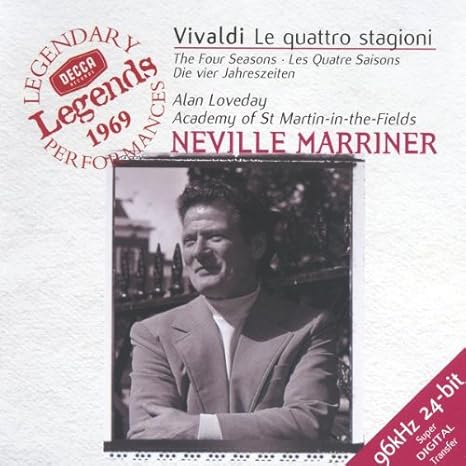
I Musici followed in 1955 with the first of several recordings of The Four Seasons with different soloists. The 1955 set with Felix Ayo was that ensemble’s first recording of any music; subsequent I Musici recordings feature Felix Ayo again in 1959, Roberto Michelucci in 1969, Pina Carmirelli in 1982, Federico Agostini in 1990, and Mariana Sîrbu in 1995. The 1969 recording by the Academy of St. Martin-in-the-Fields conducted by Neville Marriner, featuring soloist Alan Loveday, reputedly moved the piece from the realm of esoterica to that of program and popular staple.
Nigel Kennedy’s 1989 recording of The Four Seasons with the English Chamber Orchestra sold over two million copies, becoming one of the best-selling classical works ever.[11]Gil Shaham and the Orpheus Chamber Orchestra recorded The Four Seasons as well as a music video for the first movement of “Winter” that was featured regularly on The Weather Channel in the mid-1990s.
The World’s Encyclopedia of Recorded Music in 1952 cites only two recordings of The Four Seasons – by Molinari and Kaufman. By 2011 approximately 1,000 different recorded versions have been made since Campoli’s in 1939.[citation needed]
Commensurably, it has become an aspect of these recordings for classical musicians to distinguish their version of The Four Seasons from others’, with historically informed performances, and embellishments, to the point of varying the instruments and tempi, or playing notes differently from the listener’s expectation (whether specified by the composer or not). It is said that Vivaldi’s work presents such opportunities for improvisation.
Derivative works
Derivative works of these concerti include arrangements, transcriptions, covers, remixes, samples, and parodies in music—themes in theater and opera, soundtracks in films (or video games), and choreography in ballet (along with contemporary dance, figure skating, rhythmic gymnastics, synchronized swimming, etc.)—either in their entirety, single movements, or medleys. Antonio Vivaldi appears to have started this trend of adapting music from The Four Seasons, and since then it has expanded into many aspects of the performing arts (as have other instrumental & vocal works by the composer). This contest between harmony and invention (as it were) now involves various genres around the world:
1726 (or 1734)
- Vivaldi re-scored his Spring allegro, both as the opening sinfonia (third movement), and chorus (adding lyrics) for his opera Dorilla in Tempe.
1739
- Nicolas Chédeville (France) arranged Vivaldi’s four seasons (as “Le printems, ou Les saisons amusantes”), for hurdy-gurdy or musette, violin, flute, and continuo.
1765
- The French composer Michel Corrette composed and published a choral motet, Laudate Dominum de Coelis, subtitled “Motet à Grand Chœur arrangé dans le Concerto de Printemps de Vivaldi”. The work, for choir and orchestra, consists of the words of Psalm 116 set to the music from Vivaldi’s Spring movement with vocal soloists singing the solo concerto parts.
1808
- Beethoven’s Pastoral Symphony contains many of the same themes, including drunken peasants and a storm. Beethoven had acquired a solid grounding in baroque music from his teacher Albrechtsberger.
1969
- The Swingle Singers (France) recorded an album (The Joy of Singing) based on Vivaldi’s work (and other composers’).
1970
- Ástor Piazzolla (Argentina) published Estaciones Porteñas, “The Four Seasons of Buenos Aires”, and these have been included in “eight seasons” performances, along with Vivaldi’s work, by various artists.
1972
- Moe Koffman (Canada) recorded a jazz album of Vivaldi’s four seasons.
1976
- The New Koto Ensemble (Japan) recorded Vivaldi’s 4 seasons, on their koto instruments.
1978
- Michael Franks (America) composed a vocal serenade based on the theme of Vivaldi’s summer concerto (adagio). ] This was subsequently covered by WoongSan (Korea) in 2010.
1982
- Patrick Gleeson (America) recorded a “computer realization” of Vivaldi’s four seasons.
1984
- Thomas Wilbrandt (Germany) composed and recorded “The Electric V” (later adapted for film), which interprets Vivaldi’s work with ambient electronics, vocals, and samples of the original concerti.
- Roland Petit (France) choreographed a ballet (entitled “Les Quatre Saisons”) to an I Musici performance of Vivaldi’s work.
1987
- Ben Shedd (America) produced a scenic tour of nature with Vivald’s four seasons (narrated by William Shatner).
1993
- Jean-Pierre Rampal (France) recorded arrangements of Vivaldi’s four seasons for flute[20] (also recorded by Jadwiga Kotnowska).
1995
- Arnie Roth (America) recorded “The Four Seasons Suite”, including sonnets (recited by Patrick Stewart). This may or may not be considered a derivative work, depending on whether Vivaldi’s translated sonnets were meant to be narrated with the music (versus being read in Italiano, or silently by the audience).
1997
- The Baronics (Canada) recorded surf guitar versions of the violin concertos in Vivaldi’s four seasons (one movement from each).
- French musician Jacques Loussier composed and recorded, with his trio, jazz-swing interpretations of the Four Seasons.
1998
- The Great Kat (England/America) recorded a shred guitar (and violin) version of Vivaldi’s summer presto.
- Vanessa-Mae (Singapore/Britain) recorded her crossover version of Vivaldi’s summer presto, for electric violin.
Vivaldi Framework
1999
- The Chinese Baroque Players recorded arrangements of Vivaldi’s four seasons for traditional Chinese instruments.
- Petrova & Tikhonov (Russia) performed their long program to a medley of Vivaldi’s seasons to win the European Figure Skating Championships.
2000
- Venice Harp Quartet (Italy) recorded arrangements of Vivaldi’s four seasons for harp ensemble.
- es:Gustavo Montesano (Argentina) recorded a tango guitar version of the spring allegro, with the Royal Philharmonic Orchestra.
- Jochen Brusch (Germany) & Sven-Ingvart Mikkelsen (Denmark) recorded arrangements of Vivaldi’s 4 seasons for violin and organ.
2001
- Bond (Australia/Britain) recorded two singles based on Vivaldi’s winter, with electric strings (violin, cello, viola), vocals, and electronic beats. They similarly interpreted a movement from each season for Peugeot car advertisements (2009).
- de:Ferhan & Ferzan Önder (Turkish twin sisters) recorded a transcription of the Four Seasons for two pianos by Antun Tomislav Šaban.
- BanYa (South Korea) recorded a dance version of Vivaldi’s winter for the Pump it Up video game.
- Susan Osborn (America) recorded a new age vocal serenade based on Vivaldi’s winter largo.
- The Charades (Finland) recorded Vivaldi’s presto as “Summer Twist”, for surf guitar ensemble.
2003
- Red Priest (UK) recorded arrangements of Vivaldi’s 4 seasons for recorder.
- Hayley Westenra (New Zealand) adapted the musical piece called “Winter” into a song titled “River of Dreams” which is sung in English. It was recorded for her Pure album in July 10th.
2004
- Tafelmusik (Canada) arranged a cross-cultural arts special based on Vivaldi’s four seasons, involving a Chinese pipa, Indian sarangi and Inuit throat-singing.
2005
Dark Moor (Spain) recorded an electric guitar version of Vivaldi’s winter (allegro non molto), and this was later integrated into the Finnish video game Frets on Fire.
2006
- Juliette Pochin (Wales) volumed an operatic suite of sonnets to Vivaldi’s four seasons on her debut album.
- Accentus chamber choir (France) recorded a choral version of Vivaldi’s concerto for winter (complete).
- Stéphane Lambiel (Switzerland) performed his long program to a medley of Vivaldi’s seasons to win the World Figure Skating Championships.
2007
- Celtic Woman (Ireland) recorded the winter largo with vocals (Italian lyrics). The youngest former member Chloë Agnew originally recorded it for her Walking in the Air album which was released in 2002.
- PercaDu (Israel) performed an arrangement of Vivaldi’s winter (allegro non molto), for marimbas with chamber orchestra.
- Mauro Bigonzetti (Italy) choreographed a ballet of Vivaldi’s “Les quatre saisons” for a French-Canadian dance company.
- Tim Slade (Australia) directed a documentary (entitled “4”) of four classical violinists and their homelands (in Tokyo, Thursday Island, New York, and Lapland), as they relate to Vivaldi’s four seasons.
2008
- Sveceny & Dvorak (Czech Republic) produced both an album and stage production of world music based on Vivaldi’s four seasons.
- Yves Custeau (Canada) recorded a rock & roll “one man band” version of the spring allegro.
- Daisy Jopling (England/America) recorded a violin & hip-hop version of Vivaldi’s winter (allegro non molto), and also performs it reggae style.
- Innesa Tymochko (Ukrain) performed her crossover version of Vivaldi’s summer presto, for violin.
- Wez Bolton (Isle of Man) recorded a cover version of Vivaldi’s winter (allegro non molto), based on the Japanese video game “Beatmania” remix.
- Patrick Chan (Canada) performed his long program to a medley of Vivaldi’s seasons to win the Canadian Figure Skating Championships.
2009
- Absynth Against Anguish (Romania) produced an electronic (trance) version of Vivaldi’s four seasons.
- Riccardo Arrighini (Italy) recorded Vivaldi’s four seasons for solo piano, in the style of jazz.
- fr:Christophe Monniot recorded ambient jazz interpretations of Vivaldi’s four seasons.
- Christian Blind (France) recorded a surf-guitar/acid-rock version of Vivaldi’s spring allegro.

2010
- Art Color Ballet (Poland) performed their “4 elements” show to Vivaldi’s summer presto, arranged by pl:Hadrian Filip Tabęcki (Kameleon).
- David Garrett (Germany) recorded a crossover version of Vivaldi’s winter (allegro non molto), combining classical violin with modern rock music.
2011
- Black Smith (Russia) performed Vivaldi’s summer presto in the style of thrash metal music (likewise, this movement has been covered numerous times by aspiring electric guitar virtuosos, and other crossover musicians).
- Angels (Greece) performed their crossover version of Vivaldi’s summer presto, for electric strings.
- Szentpeteri Csilla (Hungary) performed her crossover version of Vivaldi’s summer presto, for piano.
- Leonel Valbom (Portugal) remixed Vivaldi’s summer presto with VST Synths.
- Tim Kliphuis (Netherlands) performed Vivaldi’s spring allegro, as a crossover of world music styles.
Vivaldi Free Download
2012
- German-born British composer Max Richter created a postmodern and minimalist recomposition released as “Recomposed Vivaldi – The Four Seasons”. Working with solo violinist Daniel Hope, Richter discarded around 75% of the original source material while the running time was reduced to 44 minutes playing time.
- Aura (Japan) recorded an a cappella arrangement of Vivaldi’s four seasons, and had also performed Vivaldi’s Spring chorus (from Dorilla in Tempe) on a prior album.
Sinfonity (Spain) performed Vivaldi’s four seasons for “electric guitar orchestra”. - Bachod Chirmof (America) produced a MIDI recording & animation of Vivaldi’s winter (movements I & III).
- Tornado Classic (Russia) performed Vivaldi’s summer presto, with electric guitar and slap bass.
- The symphonic rock band Trans-Siberian Orchestra used a portion of the first movement of the Winter Concerto in their song “Dreams of Fireflies (On A Christmas Night)” on their Dreams of Fireflies EP. The song also uses a portion of Mozart’s “Der Hölle Rache kocht in meinem Herzen,” which it had used previously.
2013
- Richard Galliano (France) recorded Vivaldi’s 4 seasons concertos for accordion, as well as a few of his opera arias on the instrument.
- Vito Paternoster (Italy) recorded Vivaldi’s Le quattro stagioni in the form of sonatas for cello.
- Periodic (Germany) produced a megamix of Vivaldi’s four seasons, which incorporates electronica with samples of the classical version.
- Steven Buchanan (America) produced a tetralogy of “midseasons” (slow movements and corresponding sonnets) from Vivaldi’s program music.
Vivaldi Framework
2014
- Si Hayden (England) recorded a solo acoustic guitar improvisation of each movement in Vivaldi’s four seasons, playing by ear.