
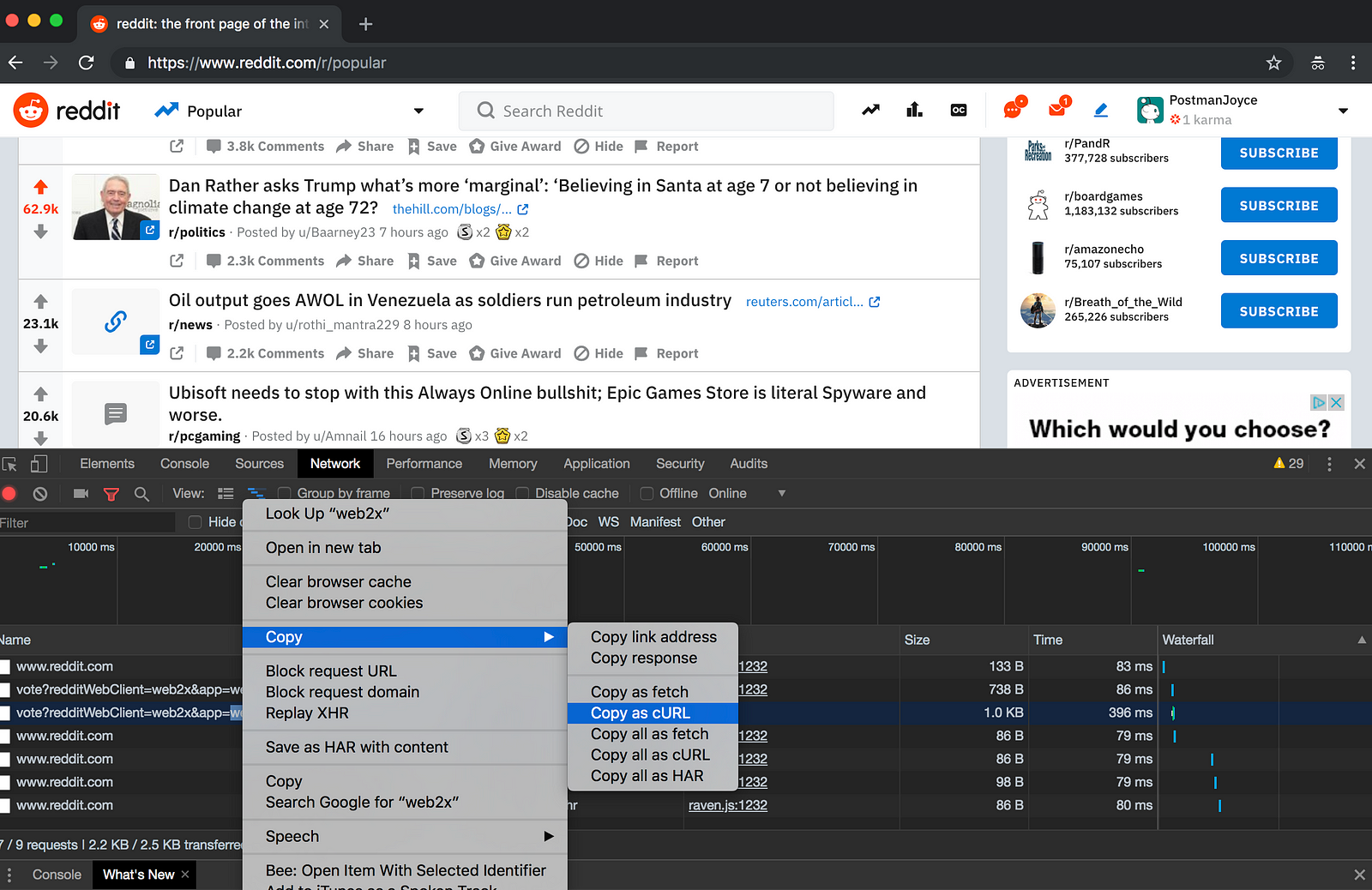
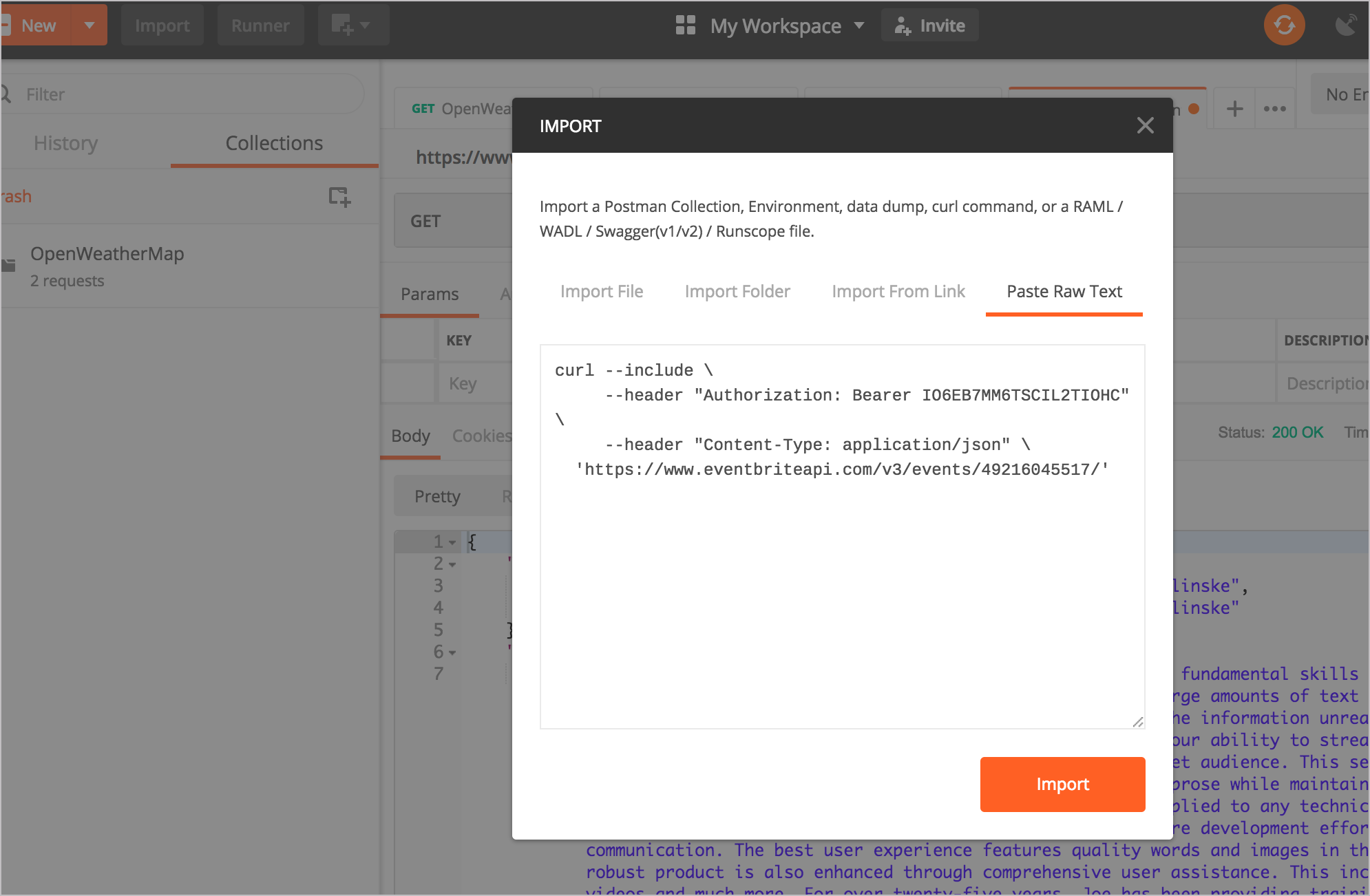
Curl - Unix, Linux Command - curl - Transfers data from or to a server, using one of the protocols: HTTP, HTTPS, FTP, FTPS, SCP, SFTP, TFTP, DICT, TELNET, LDAP or FILE. (To transfer multipl. Since you already have a valid curl request, you can actually import that and Postman will automatically convert it into a Postman call. From the main menu, click 'Import' Click 'Paste Raw Text' Paste your curl request and click 'Import'.
In Postman, select the request under your collection and click Code icon on the right panel to open the Code snippet tab. Select a language to view and copy your generated code snippet. Click the Gear icon to find additional configuration options based on your chosen language.
Hi guys!
I’ve just downloaded Postman and learning to get started. It seems pretty straight-forward with making requests to REST API based servers, although I need to make a very specific PHP cURL request to another server in order to obtain an MD5 encoded hash key to authorize my request.
I’m sure that it’s just my understanding which is holding me back from being able to make a request like this through Postman, though I have successfully done it before using XAMPP.
Below is the PHP request which I need to make, as well as a few of the different endpoints available to fetch data from.
Does anyone know if this is possible with Postman? I’ve tried using the “Import -> Paste Raw Text / Upload File” methods although it keeps saying the format is unrecognized.
This is the PHP cURL Request together with the MD5 Hash Generator to obtain a signature, by using the $key and $secret variables which need to be appended to the parameters of the endpoints called later on:
class OpenApiService{
public static function call($apiUrl, $secret, $parameters){
$signature = OpenApiService::sign($parameters, $secret);
$parameters[‘signature’] = $signature;
$postdata = http_build_query($parameters);
$ch = curl_init();
curl_setopt($ch, CURLOPT_URL, $apiUrl);
curl_setopt($ch, CURLOPT_RETURNTRANSFER, 1);
curl_setopt($ch, CURLOPT_POST, 1);
curl_setopt($ch, CURLOPT_POSTFIELDS, $postdata);
curl_setopt($ch, CURLOPT_CONNECTTIMEOUT, 10);
curl_setopt($ch, CURLOPT_TIMEOUT, 30);
$output = curl_exec($ch);
curl_close($ch);
return $output;
}
public static function download($apiUrl, $secret, $parameters, $path){
$signature = OpenApiService::sign($parameters, $secret);
$parameters[‘signature’] = $signature;
$postdata = http_build_query($parameters);
$fp = fopen($path, ‘w’);
$ch = curl_init();
curl_setopt($ch, CURLOPT_URL, $apiUrl);
curl_setopt($ch, CURLOPT_FILE, $fp);
curl_setopt($ch, CURLOPT_HEADER, 0);
curl_setopt($ch, CURLOPT_POST, 1);
curl_setopt($ch, CURLOPT_POSTFIELDS, $postdata);
curl_setopt($ch, CURLOPT_CONNECTTIMEOUT, 10);
curl_setopt($ch, CURLOPT_TIMEOUT, 30);
curl_exec($ch);
curl_close($ch);
fclose($fp);
}
public static function sign($parameters, $secret){
$signature = ‘’;
ksort($parameters);
foreach($parameters as $key=>$value){
$signature .= $value;
}
$signature = $signature . ‘@’ . $secret;
$signature = md5($signature);
return $signature;
}
}
?>

These are the endpoints which can be called to fetch different sets of data, in this instance it makes use of the class created above called OpenAPIService in the $result variable to append the parameters & MD5 hash to the Endpoint.
// Fetch the details for the product
if(false){
$apiUrl = “http://www.example.com/openapi/product!detail.do”;
$parameters = array(
‘key’ => $key,
‘itemNo’ => ‘S-MPH-6016B’
);
$result = OpenApiService::call($apiUrl, $secret, $parameters);
echo $result;
}
// Download the images
if(true){
$apiUrl = “http://www.example.com/openapi/product!getImages.do”;
$parameters = array(
‘key’ => $key,
‘itemNo’ => ‘S-MPH-6016B’,
‘size’ => ‘50’,
‘watermark’ => ‘mysite.com’
);
$path = ‘test.zip’;
OpenApiService::download($apiUrl, $secret, $parameters, $path);
}
// Fetch the countries and states
if(false){
$apiUrl = “http://www.example.com/openapi/order!getCountries.do”;
$parameters = array(
‘key’ => $key
);
$result = OpenApiService::call($apiUrl, $secret, $parameters);
echo $result;
}
// Calculate the prices and freights for the items
if(false){
$apiUrl = “http:/www.example.com/openapi/order!getPricesAndFreights.do”;
$parameters = array(
‘key’ => $key,
‘countryId’ => ‘41’,
‘items.1.itemNo’ => ‘S-IP4G-0363’,
‘items.1.qty’ => ‘20’,
‘items.2.itemNo’ => ‘S-MAC-0230’,
‘items.2.qty’ => ‘5’
);
$result = OpenApiService::call($apiUrl, $secret, $parameters);
echo $result;
}
The documentation also mentions the following: “The parameters should be sorted by the name before the signature generation.”
Additionally, if this type of request would be possible within Postman, how would you be able to fetch multiple pages worth of data in a single request (i.e loop through all of the ID’s present?)
I would really appreciate any and all assistance offered!
Thank you.
Our sample weather API doesn’t allow you to use anything but a GET method, so for this exercise, to use other methods with curl, we’ll use the petstore API from Swagger. However, we won’t actually use the Swagger UI (which is something we’ll explore later). For now, we just need an API with which we can use to create, update, and delete content.
In this example, using the Petstore API, you’ll create a new pet, update the pet, get the pet’s ID, delete the pet, and then try to get the deleted pet.
Create a new pet
To create a pet, you have to pass a JSON message in the request body. Rather than trying to encode the JSON and pass it in the URL, you’ll store the JSON in a file and reference the file.
A lot of APIs require you to post requests containing JSON messages in the body. Request bodies are often how you configure a service. The list of JSON key-value pairs that the API accepts is called the “Model” in the Swagger UI display.
Insert the following into a text file. This information will be passed in the
-dparameter of the curl request:Change the first
idvalue to another integer (a whole number in this case). Also, change the pet’s name offluffyto something else.Use a unique ID and name that others aren’t likely to also use. Also, don’t begin your ID with the number 0.
- Save the file in a directory that you can conveniently access from your terminal, such as your user directory (on a Mac,
Users/YOURUSERNAME— replaceYOURUSERNAMEwith your actual user name on your computer). In your terminal, browse to the directory where you saved the mypet.json file. (Usually, the default directory is
Users/YOURUSERNAME— hence the previous step.)If you’ve never browsed directories using the command line, here’s how you do it:
On a Mac, find your present working directory by typing
pwd. Then move up a level by typing change directory:cd ./. Move down a level by typingcd pets, wherepetsis the name of the directory you want to move into. Typelsto list the contents of the directory.On Windows, look at the prompt path to see your current directory. Then move up a level by typing
cd ./. Move down a level by typingcd pets, wherepetsis the name of the directory you want to move into. Typedirto list the contents of the current directory.
Google music manager download mac. After your terminal or command prompt is in the same directory as your JSON file, create the new pet with the following curl request:
The
Content-Typeindicates the type of content submitted in the request body. TheAcceptindicates the type of content we will accept in the response.The response should look something like this:
In the response, check to see that your pet’s name was returned.
Update your pet
Guess what, your pet hates its name! Change your pet’s name to something more formal using the update pet method.
- In the mypet.json file, change the pet’s name.
Use the
PUTmethod instead ofPOSTto update the pet’s name (keep the same curl content otherwise):
Get your pet’s name by ID
Find your pet’s name by passing the ID into the /pet/{petID} endpoint:
- In your mypet.json file, copy the first
idvalue. Use this curl command to get information about that pet ID, replacing
51231236with your pet ID.The response contains your pet’s name and other information:
You can format the JSON by pasting it into a JSON formatting tool:
Delete your pet
Unfortunately, your pet has died. It’s time to delete your pet from the pet registry.
Use the DELETE method to remove your pet. Replace
5123123with your pet ID:Now check to make sure your pet is removed. Use a GET request to look for your pet with that ID:
You should see this error message:
This example allowed you to see how you can work with curl to create, read, update, and delete resources. These four operations are referred to as CRUD and are common to almost every programming language.
Although Postman is probably easier to use, curl lends itself to power-level usage. Quality assurance teams often construct advanced test scenarios that iterate through a lot of curl requests.
Understanding idempotent methods
One concept important to understand with HTTP methods is “idempotency.” Roy Fielding defines idempotency as follows:
A request method is considered “idempotent” if the intended effect on the server of multiple identical requests with that method is the same as the effect for a single such request. Of the request methods defined by this specification, PUT, DELETE, and safe request methods are idempotent” (RFC 7231, 4.2.2.
In other words, with idempotent methods, you can run them multiple times without multiplying the results. Idempotent methods include GET, PUT, and DELETE, while POST is not (see 8.1.3 for a more detailed list).
Postman Curl Not Working
Todd Fredrich explains idempotency by comparing it to a pregnant cow. Let’s say you bring over a bull to get a cow pregnant. Even if the bull and cow mate multiple times, the result will be just one pregnancy, not a pregnancy for each mating session.
Import curl into Postman
You can import curl commands into Postman by doing the following:
- Open a new tab in Postman and click the Import button in the upper-left corner.
Select Paste Raw Text and insert your curl command:
Make sure you don’t have any extra spaces at the beginning.
- Click Import.
- Close the dialog box.
- Click Send. (If you deleted your pet, you will see the same “Pet not found” error message as before.)
Postman Curl Export
Export Postman to curl
Postman Save As Curl
You can also export Postman to curl by doing the following:
- If desired, select one of your OpenWeatherMap API requests in Postman.
Click the Code button (it’s right below Save).
- Select curl from the drop-down menu.
Copy the code snippet.
In place of
APIKEYyou should see your actual API key.- Remove the backslashes and line breaks. If you’re on Windows, change the single quotes to double quotes.
Insert the curl command into your terminal and observe the result.
Through Postman’s Import and Code functionality, you can easily switch between Postman and curl.
27/157 pages complete. Only 130 more pages to go.